Insurance providers are very specific about what they require in order to provide coverage for construction projects. What needs to be provided, in both technology & service, in order to satiate these requirements?
Addressing the need for security on building projects:

Proper insurance coverage is needed for a multitude of different reasons – whether it be for personal use, such as vehicle or home insurance, or on a larger scale for businesses; it is essential for companies to have insurance to cover liability and move forward on new projects. Builders in particular need to meet construction security requirements in order to obtain insurance for their building sites, often called “Builder Risk Security”. Different types of construction builds – wood, concrete, or other – often require their own type of insurance coverage tailored to their needs.
Failure to comply with the warranties set forth could result in all insurance coverage to become null and void – it is imperative that the builder adhere to these guidelines for their project to remain covered in the event of loss. There are liabilities that must be addressed by the builder, and working with a reputable and certified security provider is crucial for insurers to provide insurance coverage for their building project.
What type of requirements are needed?
Depending on the provider, insurance policy requirements can cover a wide range: from the need for live video monitoring & setting forth the surveillance coverage required, the implementation of visual & audio deterrents, procedures & systems for when there is a power failure, and many others that must be addressed in order for insurance companies to provide coverage. These requirements must be met within the security grid – on-site, within the security technology itself, and at a Live Remote Video Monitoring Centre.
Site Security
Many insurance providers are very specific about what is required on site for builders to comply with their policies. Some major Canadian insurers require a security provider to deliver 100% visual coverage of all entrances to a given site, while some also require 85% coverage of all roads and walkways within the site at all times. All fixed cameras within the monitoring system that are setup on site must also act as motion sensors and include detection software. All video captured must be stored for a minimum of 14 days, and output from the security surveillance system must be monitored by operators outside of working hours, with the ability to initiate Police & Fire response.

Electronic Video Surveillance
The actual functions of electronic video surveillance equipment are also subject to insurance policy requirements. Surveillance systems have to be equipped with a UPS (Uninterrupted Power Supply), with a minimum of 8 hours backup power in case of an outage. A combination of different types of security cameras are also required – from stationary cameras, to thermal imaging, PTZ (Pan-Tilt-Zoom), and Infrared Night Vision. This combination of cameras provides ample coverage of a construction site. These cameras must also be accompanied by visual and audible warning signs & devices; meant to deter potential criminal activity. Entrances and exits must be covered with motion sensors as an additional layer of security, and security equipment on site must be regularly maintained and receive repair when needed. In addition, the Monitoring Station that is keeping watch on the site must be UL Certified – which ensures the monitoring facility is adhering to strict guidelines for product testing, inspection, and certification.
How does Caliber help businesses meet (& exceed) insurance requirements?
Proactive Live Video Monitoring
Through the use of our proprietary Video Security Units, we’re able to provide full coverage of construction sites and help builders to meet & exceed their insurance requirements. Our Video Security Units include all of the necessary cameras to establish security coverage, both stationary, & PTZ (Pan-Tilt-Zoom) cameras, and can be easily outfitted with additional thermal cameras.
Each camera is equipped with IR cut filters that switch on when conditions get darker during nighttime hours. All of our sites are live monitored by our Operators at our UL Certified Monitoring Facility – from 6pm to 6am on weekdays, & 24/7 on weekends and holidays; providing continuous surveillance to deter criminals, and dispatching Police & Fire to site, when required.

Continuous Power Through Battery Backup Systems
In the event of a power failure, insurance providers require at least 8 hours of backup power. Our ability to provide consistent & continuous proactive security if there is a loss of power on-site is unmatched.
Our Battery Backup & Power Supply systems can provide several hours more than the minimum, well exceeding the insurance requirements. We provide 24 or 72 hour battery backup systems to ensure protection around the clock, even in the absence of grid power or infrastructure. Proper communication with our clients is also key – in the event of a power loss on site, an email + SMS message will be sent to key contacts of the site every 30 minutes, via our syncroAlerts software module.
That means we provide 48 contact points in that 24 hours – going above & beyond to meet and exceed insurance requirements. This is also a cost effective way to keep security systems running in the event of power loss – if power goes down overnight, and there’s only 8 hours of backup power as required in the insurance policy, guards will need to be dispatched to watch the site if the construction company can’t re-establish power to the system. In these instances, having a guard company on retainer is required to ensure guards can be dispatched on such short notice – which is another expense at the cost of the client.
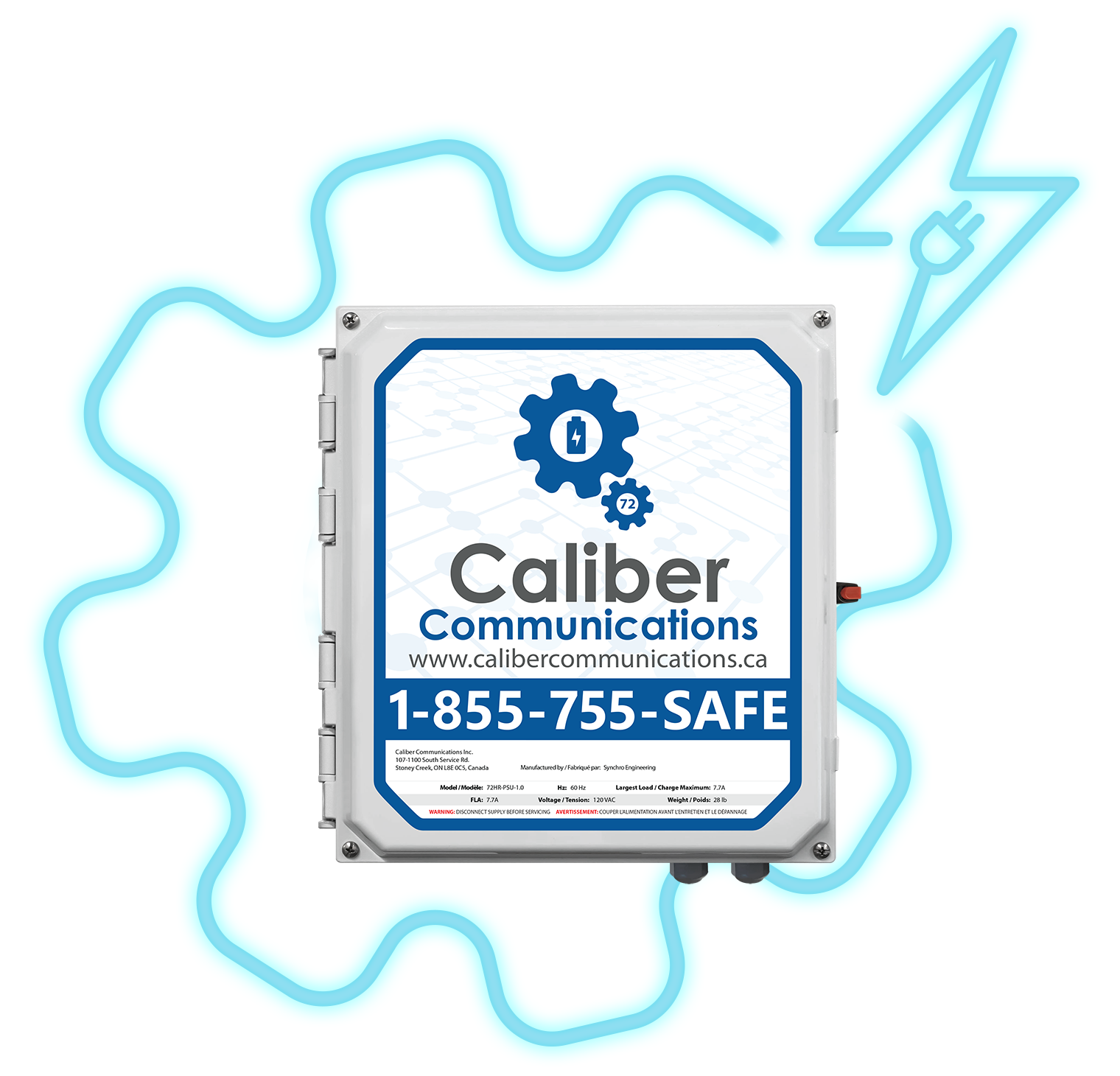
Our Battery Backup Systems are effective in a multitude of ways – through the technology we use, their tested & proven reliability, and the cost savings they provide our clients.
Utilizing Visual & Audio Deterrents
Insurance providers also require security solutions that offer visual and audio deterrents, which are the first step in deterring criminals from taking action. The placement of warning signage is the first layer, notifying potential trespassers that they are approaching private property and are being actively monitored. Bright blue LED strobe lights also signal to individuals that they are under surveillance, and the addition of audio deterrents such as loud & authoritative voice commands solidify this initial layer of security, and help businesses comply with insurance requirements.

syncroDetect Wireless Alarm System
Our proprietary wireless alarm & detection system, syncroDetect, provides another layer of security to doors and entrances as well as highly targeted areas of value – including storage trailers and sea cans, which are often present on a building site. Wireless sensors detect motion and intrusion in these areas to create additional security and comply with the requirements of insurance providers.

Expandable Storage Capacity
Storage capacity is a major consideration in the world of security, with the large file sizes that accompany video surveillance – the ability to safely store and review footage when it is needed is essential. Our Video Security Units ship standard with 2TB of video recording capacity, which provides a minimum of 21 days of video storage. Expandable storage of up to 12TB can provide up to 18 weeks of video storage, providing a level of video storage that far exceeds the requirements of insurance policies.

Investigations and Video Review
When providing security, the ability to review video footage is also key to gaining insight & evidence of what has transpired on site. Our Investigations team thoroughly review the footage and make it available to clients & insurance providers if an incident occurs; this is especially helpful if there any insurance claims and proof of theft or vandalism is required. Combined with our expanded video storage capacity, we can maintain & store important footage for as long as it is needed.