


Since its infancy, video surveillance technology has progressed tremendously. However, grainy unusable footage can still be found to this day, and this evidence could ultimately be dismissed in a court proceeding. To bypass this issue that often burdens the security industry, our team of engineers have developed technology that is capable of producing high quality live security footage, without any additional cost in bandwidth to our clients.
The Industry Standard
Security cameras are a common sight in retail stores, banks, and commercial properties, but how effective is this footage when utilized in court? Often enough, a crime is captured on video but proves to be ineffective in court due to low quality footage, unidentifiable objects, or individuals. Rick Woodburn, the president of the Canadian Association of Crown Counsel and Senior Crown Counsel in Halifax, was working a case of aggravated assault that occurred in a Nova Scotia jail.

Ultimately, there is a multitude of reasons for low quality security footage. Firstly, most video monitoring services utilize traditional internet to stream from a clients’ camera back to their video monitoring facility. Traditional internet connections are often affected by high latency, especially during peak usage times, and can significantly reduce the footage quality. Poor image quality for security camera feeds can also be attributed to data compression techniques and low resolution. Security cameras need to be operating 24/7, 365 days a year to truly be effective, and this necessity quickly amounts to large caches of data.
One strategy traditional security companies often use to mitigate this issue is to lower the resolution of the security cameras, which will reduce data consumption and result in smaller video files(2). Unfortunately, utilizing a lower resolution means a degradation in pixel density, which in turn produces lower quality footage. Data compression is another strategy that will reduce the data file size, but traditionally, it will also result in lower quality footage.
Our High Resolution Security Footage
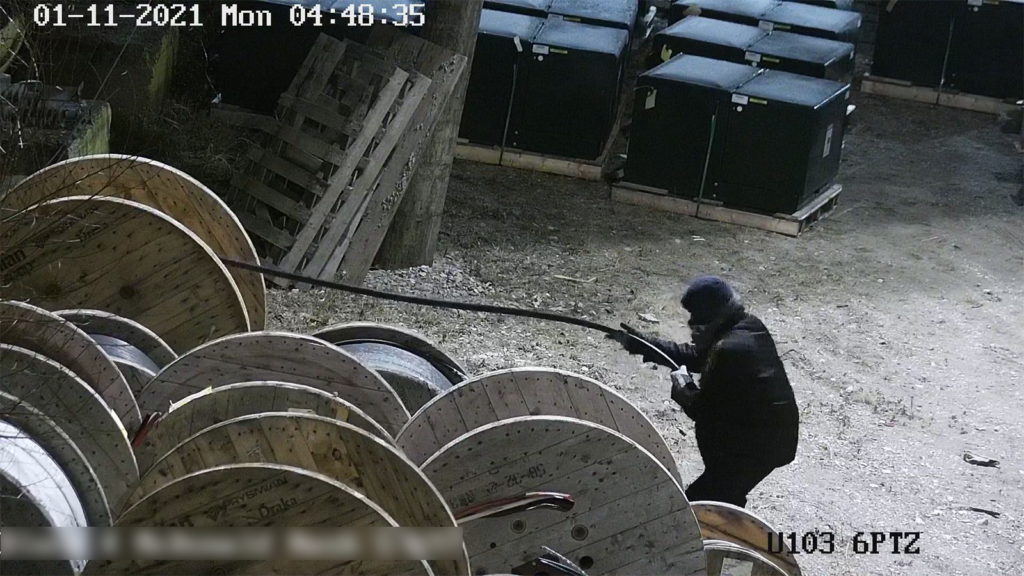
In order to retain high quality security footage, our expert team of engineers developed our video monitoring service to operator 100% on the national LTE cellular network; utilizing patented data compression and transmission techniques to maintain quality without a massive influx in data consumption. This platform and data transmission protocol allows us to deliver clear footage that can be utilized as effective evidence in court; all for a competitive price when compared to other security companies within our market space.
Concisely, this technology allows us to compress our security footage without the loss of quality that would typically occur with traditional compression methods. By utilizing our patented technology to compress the footage our systems capture, we eliminate the need to reduce the resolution of the camera, which results in significantly crisper footage at lower bandwidth requirements.
With our development and implementation of a private cellular MPLS network, we are able to operate with consistently low latency compared to the traditional internet that other security providers use. For example, when testing our MPLS network, it was discovered that the network latency was averaging at approximately 6ms, compared to the 150ms to 1000ms that traditional internet can operate at.


Other advantages of utilizing LTE cellular and MPLS technology:
No need for a wired data connection on site
Improved network security
How do we collect Court Quality Evidence?
Our operators utilize our high resolution security cameras to surveil the perimeter of the site and areas of importance. When criminal activity is identified, our operators actively deter suspects, and will use our cameras to capture key details that can be leveraged in court. These details include, but are not limited to, suspect description, location, and behavior.
Once the evidence is gathered and the threat is contained, our operators develop a time-stamped security log, detailing the chronological events of the incident. The report contains high-resolution images & video of the incident, and is sent directly to the client, as well as law enforcement, if & when required. Additionally, these security report can be accessed indefinitely for future review through our security information reporting platform, syncroReports.

Through the utilization of high resolution security cameras operating over the national cellular LTE networks & through our own private MPLS security platform, our team is able to observe, record, review, and store highly detailed security footage; video evidence that can ultimately be leveraged in the prosecution of criminals, and in civil restitution cases.
References:
- “Technology has never been better, but grainy surveillance video can doom prosecutions” CBC News, David Burke, December 29th, 2021
- “Why is The Quality of CCTV Footage So Low” Science ABC, John Staughton, January 22nd, 2022