


When labour strikes and protests arise, they can become volatile events where anything can happen. How can our proprietary surveillance technology assist with ensuring these events remain safe?
Labour strikes and protests create a unique security challenge.
Labour strikes and protests create a volatile environment that can be disruptive to municipalities, businesses, and organizations alike and require monitoring and control measures to ensure the safety and security of all.
In many instances, striking workers, protesters, and their supporters outnumber management, which creates a potentially hostile environment for both sides of the issue at hand. If a business or organization requires strike security or protest surveillance, there are some major considerations: crowd control, preventing injury and property damage, preserving the integrity of the work site for when the event ends, maintaining order, and ensuring the safety of all participants. Civil actions after strikes are becoming more common, and the need to properly monitor labour disputes is of great importance to assist in these proceedings. Developing a thorough security monitoring plan can be beneficial in the event of labour strikes, so there is no question of what protocols need to be followed – if the situation arises. (1)

The number of strikes and protests is rising.
In June 2023, over 400 employees at Hydro Ottawa went on strike for several weeks. The strike created a volatile situation on both sides of the picket line; the company still had an obligation to provide service for their customers and allow non-union workers to perform their duties. There was a number of incidents on the picket line, including picketers preventing utility crews from doing their repair work after two tornadoes wreaked havoc in the area, and materials being held up by picketers at various locations.

As such, Hydro Ottawa was granted an injunction for ‘picket line protocols’ to allow for these non-union employees and contractors to operate safely in the field. An injunction order outlines several rules around picket line delays and safety parameters around work sites. In this instance, picketers were allowed to picket their work sites, but they had to respect a safety zone of 50 feet around the property. An injunction order includes: rules around picket line delays, appropriate behavior (no harassment, intimidation, or threats), as well as the safety parameters around work sites and rule that picketers cannot follow crews from one site to another, or to their homes. A Strike monitoring program could have been leveraged in this situation to help facilitate the injunction, as well as to ensure those on the picket line adhered to the protocols set out by the picket line injunction. (2)
In September 2023, thousands of residents in Vancouver B.C. marched for climate action – an event attended by thousands of people who started their protest at City Hall before marching down the streets of Vancouver. The protest was mostly peaceful but the sheer number of participants certainly warranted the need for an active surveillance and protest management solution to keep an eye on the situation to help prevent, and document any incidents. (3)
In late 2023, over 80,000 health care workers in Quebec staged a four day walkout, joining hundreds of thousands of other public sector employees already on the picket line. The joining of these two unions created a very large labour dispute that was unprecedented in the province. Thousands of workers gathered outside the Quebec National Assembly to protest; a staggering number of people which created a volatile and unpredictable situation. Striking teachers also blocked entrances to the ports of Montreal and Quebec City, and several trucks were unable to access the port facilities, which in turn slowed down local traffic. It is estimated that around 25% of the port’s morning traffic were unable to make their transactions. (4) (5)

With unpredictable labour strikes and protests affecting a multitude of businesses and organizations, proactive surveillance and monitoring can help ensure protocols are followed and safety is prioritized.
How can our proprietary technology be leveraged for strike and protest surveillance?
Pre-Strike Planning outlines protocols and procedures
Our security professionals can assist with pre-strike planning to ensure management are on the same page prior to a strike occurring. The creation of a strike taskforce to outline the protocols and procedures that are put in place to monitor the situation is key to establishing a proper security and surveillance presence on-site. Often performed in tandem with law enforcement, pre-strike negotiations establish types of acceptable behavior, where the picket line begins and ends, as well as which entry and exit points are to be used for non-union staff to attend their jobs. Our team will offer expertise on camera placement, security challenges, and how to effectively leverage our technology to assist with strike monitoring.

Video Surveillance Units establish camera coverage
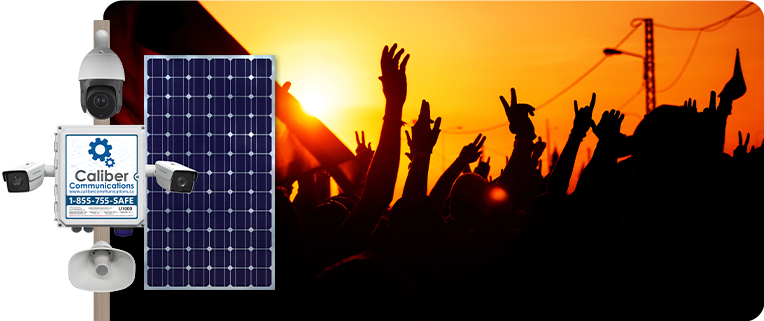
Our Video Surveillance Units come equipped with everything needed to monitor strikes and protests. By utilizing these units, management can reduce the amount of live guards and investigators needed on-site, in turn reducing costs. We leverage powerful camera technology to capture the events as they unfold on any particular site. Through a combination of stationary cameras that provide situational awareness with a fixed view, and our PTZ (Pan-Tilt-Zoom) cameras that can be zoomed in on events in high-resolution, we’ve developed a complete package that is ready to assist with strike and protest monitoring.

Cellular LTE Platform creates a wireless security grid
Our revolutionary and proprietary cellular LTE+ platform is often leveraged for proactive security, but it’s robust and fully wireless nature benefits organizations and businesses in strike and protest situations – without the need for running Ethernet cables or existing Internet infrastructure.

Mobile Security Unit takes our robust surveillance technology anywhere
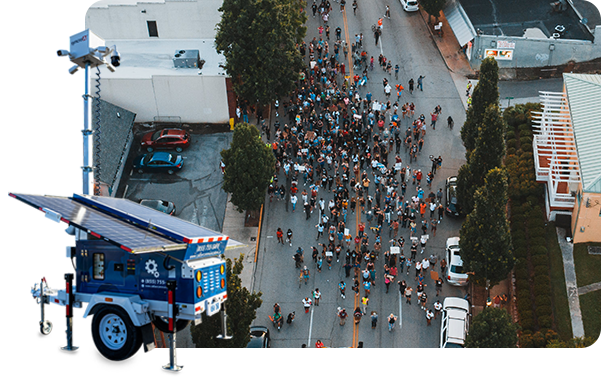
Our Mobile Security Unit (MSU) is engineered for remote sites or when rapid deployment is required – providing a full 360 degree view. Our cameras are mounted on a sturdy, telescopic pole that extends up to 7 meters. Retractable outriggers stabilize the unit, which minimizes motion on windy days. Utilizing the same technology as our fixed Video Surveillance Units, it can be deployed and adapt to the needs of any area. Labour disputes and strikes situations can escalate very rapidly, and the MSU can be deployed quickly and setup within minutes. In the event of a large public gathering like a strike or protest, the MSU can rise high up above the crowd and gain a full view of everything that occurs.
Solar Unit harnesses the power of solar energy
Our Solar Unit is ideal for sites with no existing power infrastructure or in times when grid power may be lost in an area, and includes all the features of our standard Video Surveillance Unit. While it harnesses the power of solar energy, it does so with low power consumption, a low carbon footprint, and is a fully modular solution that can adapt to the needs of any site or situation.
License Plate Reader & syncroPlates ensure vehicles have a purpose
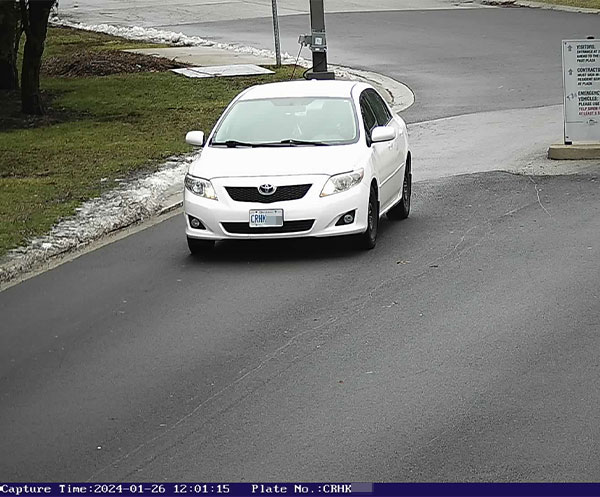
Vehicle traffic can be chaotic during a strike or protest and the ability to track and record their activity is key. Our License Plate Reader cameras track license plates and store the alphanumerical data within our database, syncroPlates. This technology offers high resolution images that can be reviewed at the click of a button – the system can send an alert if a vehicle is deemed suspicious or doesn’t belong on-site and has been ‘blacklisted’; site management and security teams can then prevent that vehicle from accessing the property. Authorized vehicles and deliveries still need access to the site, often on a specific schedule that is mutually agreed upon by all parties. Our License Plate reader cameras can also be leveraged for timing vehicle entry, which is essential for continuing operations during the course of a strike. The evidence of strikers holding vehicles up is readily available for injunction purposes, when required.
syncroReports & recorded video footage are a powerful strike management duo
We know the importance of proper site management and monitoring. Our proprietary reporting platform, syncroReports acts as your eyes on the picket line. This platform give you the ability to view live video feeds, control PTZ camera movement, and control site access. If an incident does begin to unfold, you can quickly view footage of what is occurring and take immediate action, such as contacting law enforcement. If there is a civil claim of misbehavior or violence, you can easily review footage of the incident and provide proof of what transpired. After the strike or protest concludes, your video footage can be reviewed to discern whether any action needs to be taken, or if improvements can be implemented should such a situation present itself again.

With more unions going on strike, and protests happening around the country – strike & protest monitoring can keep an eye on the situation and help hold all participants accountable in volatile and unpredictable situations.
Resources:
- “Labour Law and Strike Security”, ASIS International
- “Hydro Ottawa granted injunction for picket line protocol as workers strike continues”, Josh Pringle, CTV News Ottawa, July 24, 2023
- “Thousands turn out for Vancouver climate march”, CBC News, September 15, 2023
- “Nurses, health care workers set to join other Quebec public sector workers on picket lines”, The Canadian Press, CTV News Montreal, December 11, 2023
- “Teachers on strike block ports in Montreal and Quebec City”, Erika Morris, CBC News, December 21, 2023